| HOME | BrainWave | NEURAL | HELP | CONTACT |

|
 NeuralStack.io
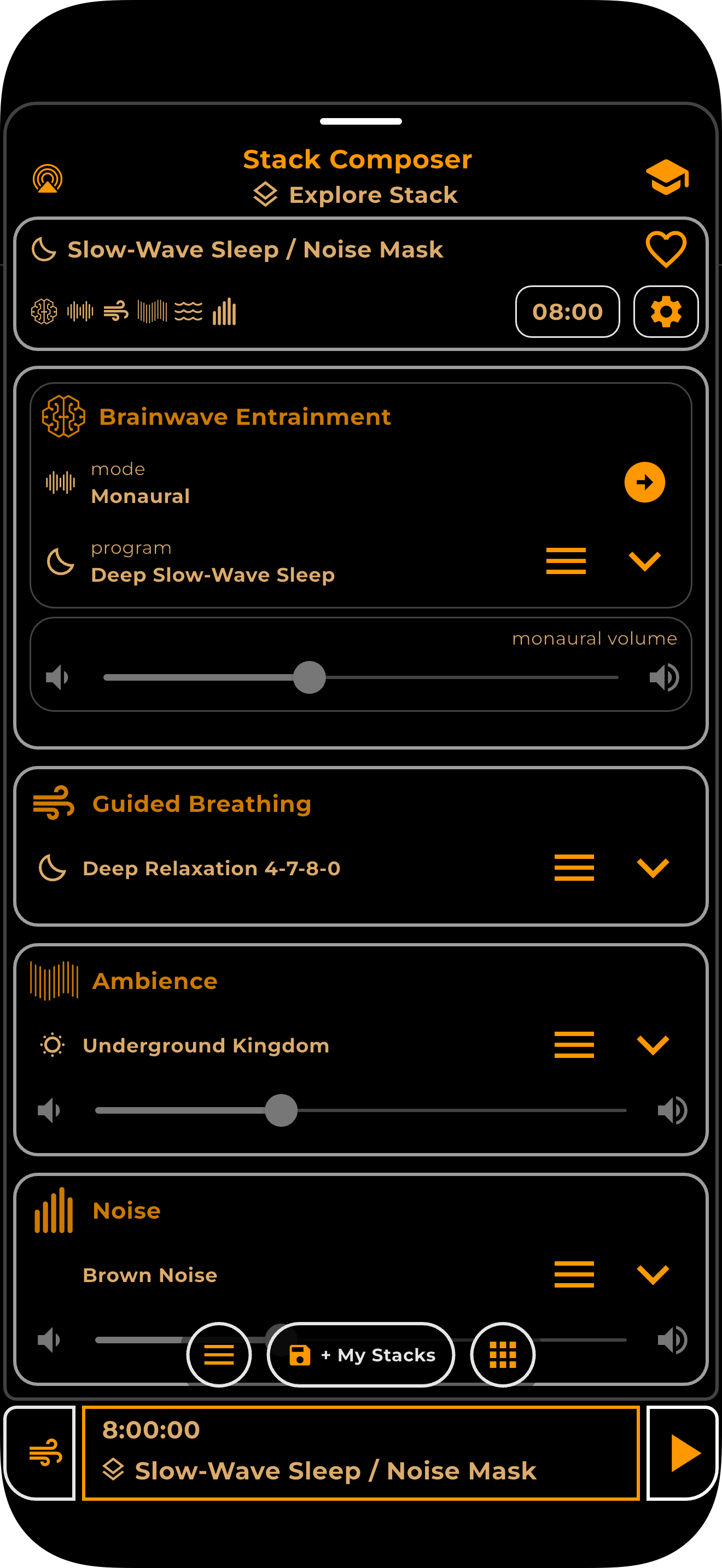
Compose your mindset with Multi-Mode Brainwave Entrainment to Enhance Focus, Relaxation, Meditation, and Sleep.
Three years in development, built on 18 years
of neural entrainment experience.
Learn more at NEURALSTACK.IO>
|
Brainwave Entrainment with NeuralStack.io
Brainwave entrainment uses precise audio frequencies to create perceivable rhythmic patterns. This guide explains the science behind binaural, monaural, and isochronic tones, how they work, and how they differ from one another.
What is Brainwave Entrainment?
Brainwave entrainment refers to the presentation of sounds that create rhythmic
patterns your brain can detect and synchronize with.
These patterns are generated when you listen to specific combinations of frequencies.
The three main tone types are binaural, monaural, and isochronic. NeuralStack.io supports all three, as well as a phase-synchronized combination of binaural and isochronic tones.
Each works in different ways and is processed differently by your auditory system.
Brainwave entrainment occurs when the auditory beat matches a brainwave frequency (.5 to 100 Hz),
and your brain's electrical activity synchronizes with the rhythm of the auditory stimulus.
Binaural Beats
How Binaural Beats Work
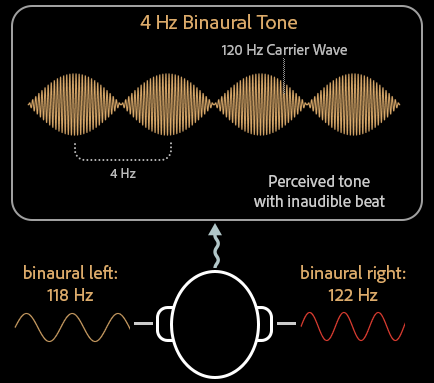
Binaural beats occur when two slightly different frequencies are presented separately to each ear (one frequency to the left ear, a different frequency to the right ear). For example, if a 200 Hz tone is played in your left ear and a 240 Hz tone in your right ear, your brain perceives an inaudible rhythmic beat at 40 Hz—the difference between the two frequencies.
This beat is not actually present in the sound itself. Instead, it's created by your brain as it processes the slight difference between the two tones. The perception feels like it's located "inside" your head rather than coming from an external source.
How Your Brain Processes Binaural Beats
Binaural beats are processed in a structure called the superior olivary complex, located in your brainstem. This is the same neural directional hearing mechanism that helps you locate sounds in space. The neurons in this area are sensitive to timing differences between your ears and fire at a rate corresponding to the frequency difference, creating the beat perception.
Important characteristics of binaural beats:
- Require headphones or earbuds (each ear must receive a different frequency)
- Work best with carrier frequencies below 1000 Hz
- Is strongest when the beat frequency is in the range of .5 - 40 Hz
- Processed centrally in the brainstem
- Create a subjective perception rather than a physical sound
Monaural Beats
How Monaural Beats Work
Monaural beats are created when two frequencies are combined before reaching your ears. Two sines waves of different frequencies are summed together, in some places reinforcing each other and in others canceling out, creating a rhythmic sonic pulse wave that fluctuates in amplitude at the beat frequency. The sound waves physically mix together, creating an amplitude-modulated signal—a real, physical beat that you can hear. This combined signal can be presented to one ear, both ears, or through speakers.
For example, when 200 Hz and 240 Hz tones are mixed together, they create a physical 40 Hz fluctuation in volume. Unlike binaural beats, this is an actual acoustic phenomenon that can be measured with a microphone.
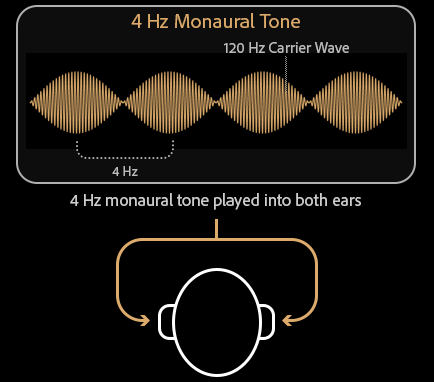
How Your Brain Processes Monaural Beats
Monaural beats are detected by your cochlea (the hearing organ in your inner ear) and then relayed through your auditory pathway to your brainstem and auditory cortex. Because they're actual physical sounds, they can be heard without headphones.
Important characteristics of monaural beats:
- Can be heard through speakers or headphones
- Physical, measurable acoustic phenomenon
- Can be perceived across a wider range of frequencies
- Processed peripherally in the cochlea
Isochronic Tones
How Isochronic Tones Work
Isochronic tones are single tones that pulse on and off at regular intervals. Isochronic tones use just one frequency that is turned on and off to create a sharp, distinct rhythmic pattern. For example, a 400 Hz tone would pulse 40 times per second to create a 40 Hz rhythm.
The regular on-off pattern creates sharp, well-defined pulses that are easy for the brain to track. The clarity of these pulses may make them more noticeable than subtle beat patterns.
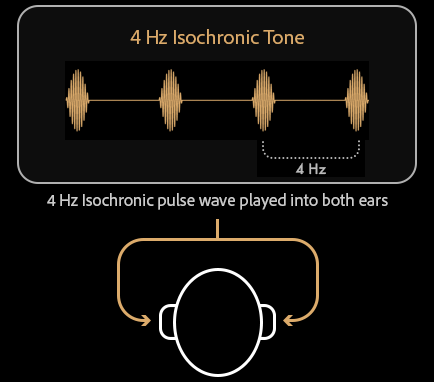
How Your Brain Processes Isochronic Tones
Isochronic tones are processed similarly to monaural beats—they're detected in your cochlea and processed through your auditory pathway. The distinct on-off pattern creates clear temporal structure that your auditory cortex can track.
Important characteristics of isochronic tones:
- Can be heard through speakers or headphones
- Use a single frequency with regular pulses
- Create distinct, sharp rhythmic patterns
- Don't require specific frequency relationships
- May be more noticeable than subtle beat patterns
- For some listeners are more appropriate for focus than relaxation or sleep due to their intensity
Combined Binaural + Isochronic
When precisely phase-synchronized, binaural beats can be combined with isochronic tones to leverage both neural processing pathways. In this approach, binaural beats provide the subtle, centrally-processed frequency difference while isochronic pulses add a clear, rhythmic structure.
This combination delivers frequency information through both the superior olivary complex (binaural processing) and the cochlear pathway (isochronic processing).
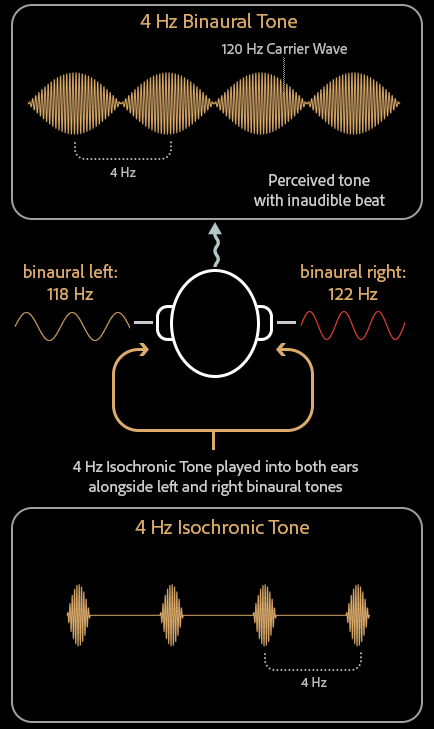
Combined approach characteristics:
- Requires headphones (for the binaural component)
- Engages both central and peripheral auditory processing
- Provides both subtle beats and clear rhythmic pulses
- Reinforces binaural beat perception with isochronic pulses
Comparison of Methods
Each method of auditory beat stimulation has distinct characteristics based on how the sounds are created and processed by your auditory system. The table below compares the key features:
| Characteristic | Binaural Beats | Monaural Beats | Isochronic Tones | Binaural + Isochronic |
|---|---|---|---|---|
| Sound Generation | Two different frequencies, one to each ear | Two frequencies mixed together before hearing | Single frequency pulsed on/off | Combination of binaural and isochronic methods |
| Perception Type | Subjective percept created by the brain | Physical acoustic beat | Physical rhythmic pulses | Both subjective and physical components |
| Delivery Method | Requires headphones/earbuds | Speakers or headphones | Speakers or headphones | Requires headphones/earbuds |
| Processing Location | Superior olivary nuclei (brainstem) | Cochlea and auditory cortex | Cochlea and auditory cortex | Both brainstem and cochlear pathways |
| Processing Stage | Central (higher-level processing) | Peripheral (early-stage processing) | Peripheral (early-stage processing) | Both central and peripheral |
| Frequency Range | Works best with carriers below 1000 Hz | Wider frequency range | Wide frequency range | Depends on components used |
| Perceptual Quality | Subtle, "phantom sound" | More obvious physical beat | Distinct, noticeable pulses | Layered, perceived + physical |
| Requires Both Ears | Yes | No (can work with one ear) | No (can work with one ear) | Yes (for binaural component) |
Understanding the Auditory Steady-State Response
When your brain is exposed to rhythmic auditory stimulation, it can produce what's called an auditory steady-state response (ASSR). This is a measurable electrical pattern in your brain that follows the rhythm of the sound you're hearing. Think of it as your brain synchronizing to the beat.
The ASSR has been extensively studied because it provides objective evidence that the brain is tracking and responding to rhythmic sound patterns. Research has shown that:
- The brain's response is stronger at frequencies corresponding to natural brainwave frequencies
- Attention and engagement can influence the strength of the response
- The response originates in the primary auditory cortex and related brain regions
Factors That Influence Effectiveness
Research has identified several factors that can affect how well auditory beat stimulation works:
Stimulus Parameters
- Carrier frequency: Lower carrier frequencies (below 1000 Hz) tend to produce more robust effects than higher frequencies
- Duration: Longer exposure periods may be needed to observe consistent effects
- Volume: The stimulus needs to be audible but not uncomfortably loud
Brainwave Entrainment Benefits
- Increased attention and vigilance
- Improved memory recall
- Enhanced cognitive performance
- Lower anxiety and stress levels
- Improved problem-solving and reasoning
- Enhanced meditation and relaxation
- Improved sleep quality
How NeuralStack.io Uses These Techniques
NeuralStack.io incorporates binaural beats, monaural beats, and isochronic tones as elements you can combine and customize in multi-stage experiences. Rather than offering fixed, one-size-fits-all sessions, the app lets you:
- Choose which type of stimulation you prefer (binaural, monaural, isochronic, or combined binaural and isochronic)
- Adjust frequency parameters to explore different patterns
- Combine auditory beat stimulation with other elements like guided breathing, ambient sounds, and nature sounds
- Create multi-stage progressions that change over time
- Save and refine your personal configurations
This flexibility allows you to remix, create, and discover what works best for you, based on your individual preferences and goals.


|
Reviews for NeuralStack.io |
|
 I’ve been using NeuralStack for about a week and I’m obsessed with making it the soundtrack of my day. From morning focus sessions, and meditative mid-afternoons, to power naps and early evening relaxation, I love dialing in the right track, beat, brainwave and ambience with the stack editor. Brilliant idea. There are plenty of presets to explore and I use several of these but I’ve also created a half dozen personal favorites to match my mood and desired outcome. Love this app. Having used this developers products in the past I was very interested in the numerous options to create my own combination of stack items to address areas of sleep, and concentration. The variety of options, including that of music makes this app the complete package. Having used Binaural toning on my iPhone/iPad and now with M-series chip, on MacOS for more than 14 years. The crafted stacks bring a new level of sleep, study, focus, and calm reflection to my life. I really like that this app lets you play tones in the background behind your tasks, YouTube videos, movies, tv shows, or whatever to keep you living your best. The new option to go in to a pre-built track, and edit the settings so skillfully built, I can fine tune them to my specific needs. Adjusting carrier tones, or the length, and start of the tracks. I have already built a library of 14 custom tracks from the pre-sets. I specifically like the wake timer setting, letting you pick a period to nap/sleep, and the tones will be distributed over that period either by %, or by minimum time, ending in a wake-up tone that sets you just right state of mind. (Gamma) I have used other apps by this developer, and have gifted prior apps to family, and to friends so that they can have the same power over their mental clarity that l've become to trust. Definitely give this app a go! Create and master your own personal wardrobe of brainwave states. We all have different emotional needs and challenges. By adding the breathing routines, I am getting both positive brain frequency training and physical alignment at the same time. Thank you for diving so deep! |
|